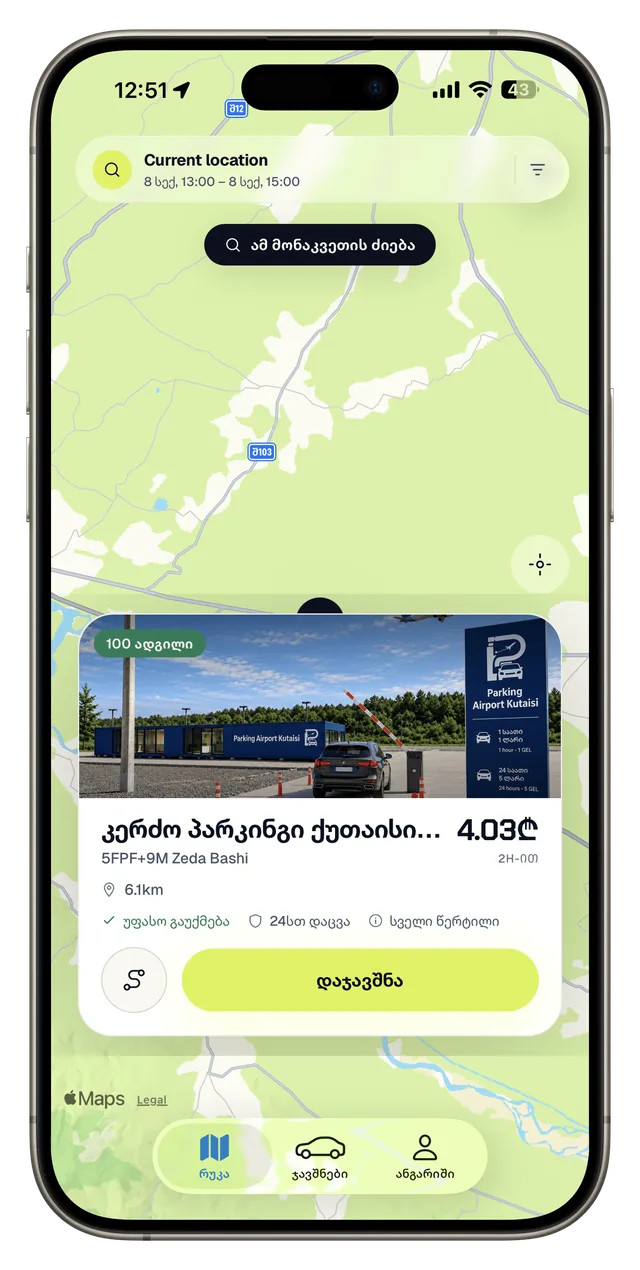
Turn empty parking spaces into revenue.
MoveDI connects your facility to a network of drivers who can find, book, and pay for a space in advance, directly from their phone.
// no hardware required// instant onboarding · 48h// pay only when we earn
Most facilities sit half-empty during peak hours. Drivers circle the block looking for spots they can't see. MoveDI fixes the matching problem without changing your setup.
MoveDI helps drivers find, book, access and pay with ease, while giving you full control of pricing, capacity, and access rules.
Track occupancy, analyse trends, and optimise your space. Heatmaps by hour and day, revenue per bay, repeat-driver retention.
Automate entry and exit with secure, touch-free access. Plate recognition reads the booking and opens the gate.
Assign spaces, set access rules, configure pricing and manage bookings. Sync with your existing PMS or run standalone.
Drag the sliders. This is the gross value of the parking itself — what drivers pay at the rates you set, before any commercial terms.
MoveDI plugs straight into the cameras, parking-management systems, and barrier gates already installed in your facility. No rip-and-replace, no new hardware on the wall. We connect over standard protocols and you're earning before the week is out.
Standard integrations live in 48 hours. Custom ones in under two weeks.
We talk to your existing ANPR, PMS, and barrier gates over open protocols.
Tbilisi-based engineers who know the equipment installed in Georgia.
A parking business sells time, not space: a driver pays for the period their car occupies a bay. Three numbers decide the revenue: how many bays you have, how full they get, and at what rate. The second is the one most often ignored.
Planning a paid car park does not start with the rate. First you need to know when your facility fills and when it empties across a week, because that curve is what tells you which model works: hourly, daily, monthly, or all three at once.
Running paid parking properly rests on three decisions: who gets in, how they pay, and what happens when they do not. If all three have a clear answer and every session is recorded, the rest is detail.
Parking layout has two sides. One is regulatory: dimensions, clearances, ramps and safety, which your designer and the applicable norms decide. The other is commercial: those same decisions determine what the car park earns for years afterwards. This guide is about the second.